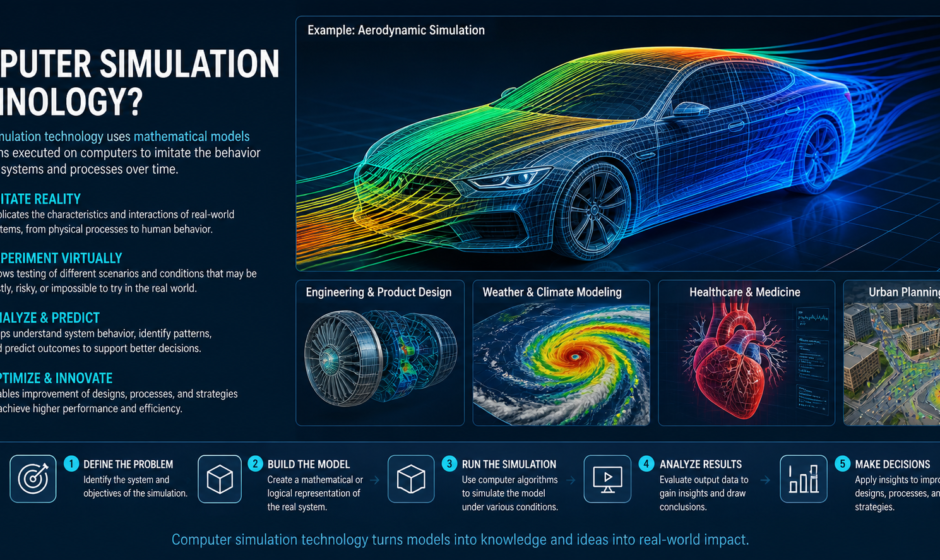

Computer simulation technology has evolved from a niche scientific tool into a foundational pillar of modern industry, research, and professional training. By creating digital representations of complex systems, it allows us to predict the future, analyze the past, and practice high-stakes tasks without real-world consequences.
I. What is Computer Simulation Technology?
At its core, computer simulation technology is the use of mathematical models and computational power to replicate the behavior of a real-world system. It acts as a “virtual laboratory” where variables can be manipulated to see how a system responds over time.
- Model vs. Simulation: A “model” is the static mathematical representation of the system, while a “simulation” is the execution of that model to observe it in action.
- Predictive Power: It allows organizations to conduct “what-if” analysis, identifying potential failures or bottlenecks before a physical prototype is ever built.
- Safety and Cost-Efficiency: Simulations provide a risk-free environment for testing scenarios that would be too dangerous, expensive, or physically impossible to perform in reality.
II. Core Components: Software and Models
The effectiveness of a simulation depends on the quality of its underlying components.
- Computer Simulation Software: Specialized programs like MATLAB, AnyLogic, and SimScale provide the engines required to process complex equations.
- Simulation Models: These are the digital blueprints of the system being studied. They can be “deterministic” (producing the same result every time) or “stochastic” (incorporating randomness, like weather patterns).
- Computer Modelling Examples:
- Climate Change Models: Simulating decades of atmospheric data to predict global temperature shifts.
- Aerodynamics: Testing the “drag” on a new car design in a virtual wind tunnel.
- Supply Chain Logistics: Simulating warehouse traffic to optimize shipping routes.
III. Specialized Training: The Case of Loan Officers
One of the most practical applications of this technology is in professional skill development, particularly in the financial sector.
- What is Computer-Simulated Training Technology for Loan Officers? This is a specialized form of simulation that mimics the high-stakes environment of credit lending and risk assessment.
- Risk-Free Skill Building: Loan officers can process “simulated” loan applications that feature complex financial histories, varying credit scores, and regulatory hurdles.
- Immediate Feedback: These simulations provide instant results on whether a decision would have led to a “default” or a successful loan, allowing the officer to refine their judgment without risking the bank’s capital.
- Regulatory Compliance: It ensures that officers are trained to identify fraudulent patterns and adhere to the latest financial laws in a controlled setting.
IV. The Future: Digital Twins and AI Integration
As we move further into 2026, simulation technology is becoming increasingly “alive.”
- Digital Twins: Unlike traditional simulations, a Digital Twin is a virtual model that is connected to its physical counterpart via real-time data sensors. If a machine in a factory begins to overheat, the digital twin reflects that change immediately, allowing for predictive maintenance.
- AI Enhancement: Artificial Intelligence is now being used to run millions of simulation iterations simultaneously, finding the “optimal” design or strategy much faster than a human operator could.
- Cloud Scalability: Modern computer simulation software increasingly lives in the cloud, allowing small businesses to access massive computational power that was once reserved for global corporations.
Conclusion
By enabling the virtualization of high-risk scenarios, this technology transforms abstract data into actionable foresight. As we move deeper into an era defined by “Digital Twins” and AI-driven modeling, the ability to iterate in a consequence-free environment becomes a competitive necessity. It ensures that innovation is no longer limited by physical trial and error, but rather by the speed of computational logic. Ultimately, computer simulation technology serves as a vital safety net, allowing humanity to push the boundaries of engineering, finance, and science with unprecedented confidence and precision.