
The Alien Genius Beneath the Waves
For decades, marine biologists and curious observers alike have asked the same question: are octopus smart? As we move into 2026, the evidence for their high-level cognition has only grown more compelling. These eight-armed wonders represent a form of intelligence that is fundamentally different from our own. While mammals evolved intelligence through a centralized nervous system, the octopus took a radically different evolutionary path, resulting in what many experts describe as an ‘alien’ mind.
The octopus belongs to the class Cephalopoda, a group that includes squid and cuttlefish. However, the octopus stands alone in its documented ability to solve complex puzzles, use tools, and even exhibit play behavior. To understand his intelligence, one must look past the slimy exterior and into a neural architecture that defies traditional biological norms.
A Decentralized Brain: Thinking with Eight Arms
One of the most fascinating aspects of octopus biology is that his brain is not confined to his head. While he does have a central brain, approximately two-thirds of his neurons are located in his arms. This means that each arm can essentially ‘think’ for itself. An arm can taste, touch, and even decide how to move without waiting for a command from the central nervous system.
This decentralized intelligence allows the octopus to perform multiple complex tasks simultaneously. For instance, he can be focused on hunting a crab with one arm while another arm is busy investigating a crevice for potential threats. This level of parallel processing is something that researchers studying computer simulation technology often use as a biological model for distributed computing and robotics.
Problem-Solving and Tool Use
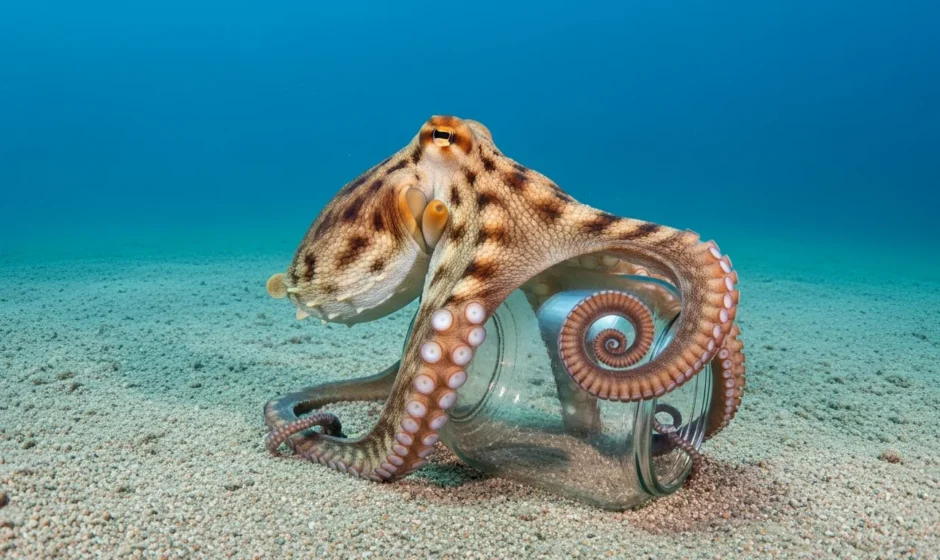
The intelligence of the octopus is perhaps most visible in his ability to solve problems. In laboratory settings, he has been observed unscrewing jars to reach food, navigating intricate mazes, and even escaping from high-security tanks. His curiosity is a hallmark of a high-functioning mind; he does not just react to his environment, he explores it with intent.
Tool use, once thought to be a uniquely human or primate trait, is well-documented in certain species like the Veined Octopus. He has been seen carrying coconut shells across the seafloor, later assembling them into a protective fortress. This behavior demonstrates foresight and planning, as he carries the ‘tools’ with him even when they are not immediately needed. This level of natural history documentation is something that figures like Robert Attenborough and his predecessors have spent years bringing to the public eye, highlighting the sophisticated lives of non-human animals.
The Art of Deception: Camouflage as Intelligence
While many animals use camouflage, the octopus uses it with a level of cognitive control that is staggering. He can change the color and texture of his skin in less than a second to match his surroundings perfectly. This is not a simple reflex; it is a calculated decision. He must visually process his environment and then instruct his chromatophores (pigment-changing cells) to mimic the specific patterns of coral, sand, or seaweed.
Social Learning and Memory
Despite being largely solitary creatures, octopuses have shown a remarkable capacity for learning. He can learn by observing others, a trait known as social learning. Furthermore, his short-term and long-term memory systems are highly developed. He can remember the specific faces of human keepers, reacting differently to a man who feeds him versus a man who might have previously bothered him with a net.
- Spatial Memory: He can remember the layout of his hunting grounds over vast distances.
- Observational Learning: He can solve a puzzle faster after watching another octopus do it.
- Play Behavior: He has been observed ‘playing’ with objects, such as bouncing a ball against a water stream, which is a key indicator of higher intelligence.
Frequently Asked Questions
Do octopuses have nine brains?
Technically, an octopus has one central brain and eight clusters of nerve cells (ganglia) in each arm. These ganglia act as mini-brains, allowing the arms to act independently, which leads to the common saying that they have nine brains.
How smart is an octopus compared to a dog?
It is difficult to compare intelligence across species, but many researchers suggest that an octopus has a cognitive complexity similar to that of a dog or a young child. His ability to use tools and solve puzzles puts him in an elite group of intelligent animals.
Can an octopus recognize humans?
Yes, studies have shown that an octopus can distinguish between different individual humans. He often displays unique behaviors, such as squirting water or approaching the glass, based on his past interactions with a specific person.
How long do octopuses live?
Despite their high intelligence, most octopuses have a relatively short lifespan, ranging from one to five years depending on the species. This short life makes their ability to learn and adapt so quickly even more impressive.