
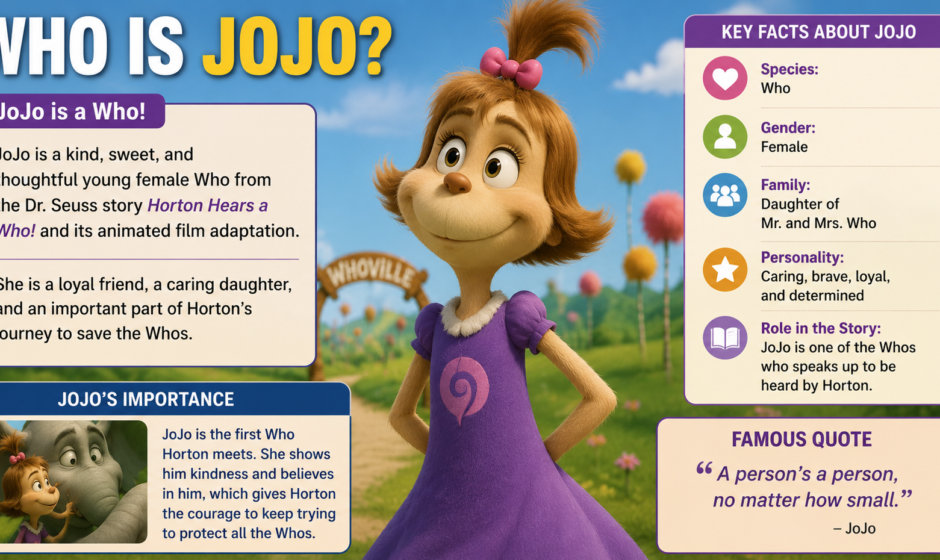

In the whimsical, rhyming world of Dr. Seuss, few characters carry as much weight as the smallest resident of a speck of dust. If you have ever wondered who is JoJo from Horton Hears a Who, you aren’t just looking for a name; you are uncovering the story of a character who represents the power of the individual.
Whether you remember him from the classic 1954 book or his “emo” reimagining in the 2008 blockbuster film, JoJo remains the ultimate proof that “a person’s a person, no matter how small.”
1. Who is JoJo? (AEO Direct Answer)
JoJo McDodd is a central character in Dr. Seuss’s Horton Hears a Who!. He is the oldest child and only son of Ned McDodd, the Mayor of Whoville. Though he is the “smallest Who of all,” JoJo is the hero of the story; his final, resounding cry of “Yopp!” is the specific sound that finally breaks through the atmosphere of the speck, allowing the animals in the Jungle of Nool to hear the Whos and saving the entire civilization from destruction.
2. The 2008 Film: A New Vision of JoJo
While the original book depicts JoJo as a very small child, the 2008 Blue Sky Studios film reimagined him as a brooding, misunderstood teenager. This version of JoJo added layers of complexity to the Whoville hierarchy.
The Only Son Among 97 Children
In the film, Mayor Ned McDodd has 96 daughters and only one son, JoJo. This creates a massive amount of pressure on the boy, as he is “next in line” to be the Mayor of Whoville—a role he feels he is entirely unsuited for.
The Symphony of Noise
Unlike his father, who is a boisterous public speaker, JoJo is nearly silent throughout the movie. Instead of speaking, he expresses himself through inventive genius. He builds a massive, elaborate musical contraption in an abandoned observatory, which he calls the “Symphony of Noise.” This invention becomes crucial during the climax of the film, providing the sonic power needed to alert the outside world.
3. Is JoJo a Boy or a Girl?
This is one of the most frequent questions from fans, likely due to JoJo’s long hair and slender, “emo-style” character design in the 2008 movie.
- The Answer: JoJo is a boy.
- Context: In both the book and the film, he is explicitly referred to as the Mayor’s son. His design in the movie was intended to reflect the “alternative” or “counter-culture” youth of the mid-2000s, emphasizing his status as an outsider within his own family.
4. The Voice Behind the Character: Jesse McCartney
To bring the 2008 version of JoJo to life, the filmmakers cast pop star and actor Jesse McCartney.
McCartney’s performance was unique because the character is largely non-verbal. He had to convey JoJo’s emotions—frustration, curiosity, and eventually bravery—through breaths, sighs, and the occasional spoken line. McCartney’s soft, youthful voice perfectly captured the vulnerability of a “small” person trying to find his place in a loud world.
5. Book vs. Movie: A Semantic Comparison
| Feature | 1954 Original Book | 2008 Animated Film |
| Age | A young child | An adolescent/teen |
| Personality | “Shirking” his duty | Creative and misunderstood |
| Contribution | Shouts a single “Yopp!” | Orchestrates a musical symphony |
| Family | Part of a massive family | Only son among 96 sisters |
| Status | The smallest Who of all | The Mayor’s reluctant successor |
6. The Significance of the “Yopp!”
Thematically, JoJo is the most important character in the Horton mythos because he represents the tipping point.
The Mayor and all the other Whos were shouting, but their combined volume wasn’t enough to reach the ears of the Sour Kangaroo. It took the addition of one more voice—the smallest one—to bridge the gap. This serves as a powerful metaphor for civic duty and the importance of every individual in a society. In 2026, this message remains a cornerstone of children’s literature and film.
7. Summary: Why We Love JoJo
JoJo McDodd reminds us that greatness doesn’t come from volume or stature; it comes from having the courage to add your voice when it matters most. From his silent beginnings in an observatory to his world-saving shout, JoJo is a testament to the quiet power of the “smallest” among us.

