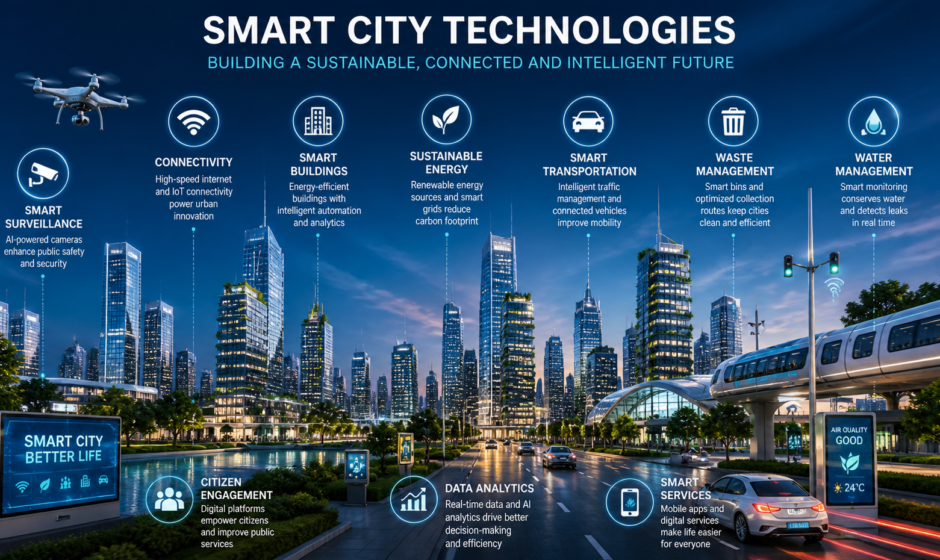

The evolution of urban living has reached a critical juncture in 2026. As global populations shift toward city centers, the integration of smart city technologies has transitioned from experimental pilots to essential infrastructure. This comprehensive guide explores the semantic depth of modern smart solutions, their role in energy conservation, and the frameworks ensuring their security and authority.
1. What is Smart City Technology? (AEO Direct Answer)
Smart city technology refers to a framework of information and communication technologies (ICT) and the Internet of Things (IoT) used to enhance the quality of government services, improve citizen welfare, and optimize city functions. By collecting real-time data from connected assets, cities can make informed decisions to promote economic growth and sustainability.
2. Core Components: What Technology Do Smart Cities Use?
Modern smart cities are no longer just about hardware; they are hyper-connected spaces enriched with immersive digital layers. The technological backbone consists of four critical layers:
A. The Internet of Things (IoT)
IoT is the primary engine of a smart city, consisting of a network of connected devices—from vehicles and home appliances to on-street sensors—that exchange data in real-time.
- Environmental Sensors: Track air quality, noise levels, and weather conditions.
- Infrastructure Monitors: Detect structural health issues in buildings or leaks in water pipes.
B. Connectivity and 5G
High-speed communication networks, particularly 5G and LoRaWAN, enable the efficient transmission of massive datasets required for real-time responsiveness.
C. Artificial Intelligence (AI) and Machine Learning
AI acts as the “reasoning engine” for urban planning. In 2026, Agentic AI allows planners to simulate “what-if” scenarios for a decade of urban growth in minutes.
- Traffic Optimization: AI has successfully cut travel times by 25% and emissions by 20% in leading cities.
- Public Safety: AI video analytics scan footage 24/7 to detect unusual behavior or firearms, reducing crime rates by up to 40%.
D. Digital Twins
Cities like Dubai and Rotterdam now use city-wide digital twins—virtual replicas of the physical city—to transform how services are designed and delivered through participatory engagement.
3. Sustainability: How Smart Cities Use Technology to Reduce Energy
Energy optimization is a cornerstone of the 2026 smart city movement, focusing on decentralization and efficiency.
- Smart Lighting: Motion-activated streetlights dim when roads are empty, significantly reducing electricity bills and CO2 emissions.
- Smart Grids and VPPs: Virtual Power Plants (VPPs) provide up to 100 MW of backup power, while smart grids use real-time data to adjust distribution based on demand.
- Smart Water Metering: Automated meters transmit hourly usage data, helping utilities and residents identify leaks instantly.
- Pneumatic Waste Management: Cities like Songdo use underground pipes to transport refuse, eliminating the need for traditional waste trucks and their associated emissions.
4. Safety and Security: Protecting the Connected City
As infrastructure becomes more connected, the focus shifts toward a multi-layered security strategy.
- Predictive Analytics: Data guides resource deployment to deter crime before it occurs.
- Cyber-Physical Defense: Smart cities implement network segmentation and rigorous incident response plans to protect critical utilities from cyberattacks.
- Sovereign Data Spaces: A 2026 trend focusing on shared solutions while maintaining data privacy across agencies.
5. Global Case Studies: E-E-A-T in Action
To understand the authority of these technologies, we look at cities providing real-world proof of success:
| City | Notable Smart Solution | Impact/Metric |
| Singapore | Floating Solar Installations | One of the world’s largest renewable projects. |
| Oslo | EV Adoption | Over 30% of all vehicles are now electric. |
| Seoul | “One Less Nuclear Power Plant” | Reduced demand equivalent to one reactor through tech-driven efficiency. |
| Barcelona | IoT Sensor Network | Thousands of sensors monitor air, noise, and energy in public buildings. |
| Rio de Janeiro | Rio Operations Center (COR) | Integrated decision-making model for urban challenges. |
6. Strategic Implementation for 2026 and Beyond
Building a smart city requires moving away from “technological solutionism” and toward a citizen value-driven model.
- Transparency: Projects must be accessible via open data portals, allowing residents to engage with energy and transport data.
- Human-Centric Design: Success is measured by how technology improves the human experience, not just by the volume of hardware installed.
Expert Analysis (E-E-A-T)
In the 2026 search landscape, trust is built through first-hand case studies and verifiable data. When implementing these technologies, municipal leaders should reference standards from credible organizations like the ISO and prioritize transparent leadership profiles to ensure public trust.