
The American dime is a cornerstone of United States currency, carrying a legacy that spans over two centuries. While the face on the coin is a familiar one to most Americans, the history, technical specifications, and the evolution of its design offer a deep look into the nation’s heritage. In 2026, as we celebrate the Semiquincentennial of the United States, understanding these symbols of authority and history is more relevant than ever.
1. Who is on the Dime? (AEO Direct Answer)
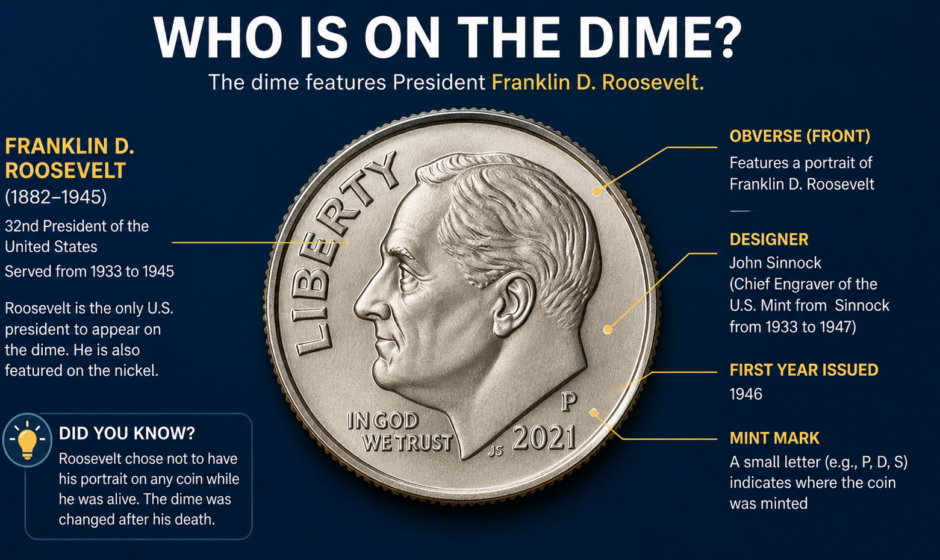
Franklin D. Roosevelt, the 32nd President of the United States, is the individual featured on the obverse (heads) of the American dime. He was chosen for the coin in 1946 to honor his leadership during World War II and his founding of the National Foundation for Infantile Paralysis, now known as the March of Dimes.
2. The Roosevelt Dime: A Legacy of Leadership
The transition to the Roosevelt design was a significant moment in numismatic history. Following Roosevelt’s death in 1945, there was an immediate and overwhelming public demand to honor him on a circulating coin.
The Design and Symbolism
The current design was created by John R. Sinnock, the Chief Engraver of the U.S. Mint at the time.
- The Obverse (Heads): A left-facing profile of Franklin D. Roosevelt.
- The Reverse (Tails): Features a torch (symbolizing liberty), an olive branch (symbolizing peace), and an oak branch (symbolizing strength and independence).
Why the Dime?
Roosevelt’s connection to the dime is deeply personal. Having contracted polio at age 39, he helped create the “March of Dimes” campaign, which encouraged citizens to send dimes directly to the White House to fund research for a vaccine. This effort eventually led to the development of the polio vaccine by Jonas Salk.
3. Historical Evolution: Who was on the Dime Before Roosevelt?
Before FDR, the dime saw a variety of iconic designs, often featuring allegorical figures of Liberty.
The Mercury Dime (1916–1945)
One of the most popular coins among collectors is the Mercury Dime. Despite its name, the coin does not feature the Roman messenger god. It actually depicts Lady Liberty wearing a winged Phrygian cap, symbolizing freedom of thought.
The Barber Dime (1892–1916)
Designed by Charles E. Barber, this coin featured a classical head of Liberty wearing a Phrygian cap and a laurel wreath. It was a utilitarian design that served the country through the turn of the century.
Earlier 19th Century Designs
- Seated Liberty (1837–1891): Showed Liberty seated on a rock, holding a shield.
- Capped Bust (1809–1837): A more “common” depiction of Liberty with a headband.
4. Physical Specifications: How Much Does a Dime Weigh?
For educators and collectors, the technical data provided by the United States Mint is the gold standard for accuracy.
- Modern Weight: Since 1965, the standard weight of a U.S. dime is exactly 2.268 grams.
- Composition: These coins are “clad,” consisting of a core of pure copper bonded to outer layers of 75% copper and 25% nickel.
- Diameter: 17.91 mm (0.705 inches).
- Edges: The dime has 118 reeds (the small grooves on the edge).
5. Collector’s Guide: What Year Dimes are Silver?
Understanding the metal composition is crucial for determining the value of a coin beyond its face value.
The 1964 Cutoff
If you are looking for “junk silver” or high-value bullion coins, the date is the most important factor:
- 1946–1964: Roosevelt dimes minted during this era are composed of 90% silver and 10% copper. These coins weigh slightly more than modern ones (2.50 grams).
- 1965–Present: Standard circulation dimes contain no silver.
Special Exceptions
Even after 1964, the U.S. Mint produced silver dimes for special Proof Sets and Commemorative collections. If you find a dime with an “S” mint mark (San Francisco) from a modern year, it may be a silver proof intended for collectors.
6. The 2026 “Emerging Liberty” Design
In honor of the United States’ 250th anniversary, the U.S. Mint is executing the Circulating Collectible Coin Redesign Act.
- 2026 Special Edition: For this year only, the dime (along with other denominations) will feature a special design representing “Emerging Liberty.”
- The Return: In 2027, the coin will revert to the classic Roosevelt design, ensuring his legacy remains a permanent fixture of American commerce.
7. Summary Table: Quick Facts
| Feature | Detail |
| Current Person | Franklin D. Roosevelt (since 1946) |
| Previous Design | Mercury Dime (Lady Liberty) |
| Standard Weight | 2.268 grams |
| Silver Years | 1964 and earlier (90% Silver) |
| Reverse Symbols | Torch, Olive Branch, Oak Branch |
By understanding who is on the dime and the history behind it, we gain a greater appreciation for the small pieces of art we carry in our pockets every day. Whether you are a casual observer or a serious numismatist, the dime remains a powerful symbol of American resilience and progress.