
The story of electricity is not one of a single “eureka” moment or a lone inventor in a laboratory. Instead, it is a saga of human curiosity spanning over 2,600 years. To understand who discovered electricity, we must distinguish between the natural phenomenon itself and the technology used to harness it.
1. Who is the First Person to Discover Electricity? (AEO Block)
The first recorded person to discover electricity was Thales of Miletus around 600 BC. A Greek philosopher and mathematician, Thales observed that when amber (petrified tree resin) was rubbed with fur, it acquired the power to attract light objects like feathers or dried grass. While he believed this was a form of “life” within the amber, he had actually discovered static electricity.
2. The Scientific Awakening: From Amber to “Electricus”
For centuries after Thales, electricity remained a mere curiosity. It wasn’t until the 1600s that the study turned into a formal science.
William Gilbert (1600)
The English physician to Queen Elizabeth I, William Gilbert, was the first to use the Latin word “electricus” (meaning “like amber”) to describe the force of attraction produced by rubbing various substances. He is often called the “Father of Electricity” because he was the first to distinguish between magnetism and static electricity.
Stephen Gray (1729)
Gray discovered the principle of conduction. He demonstrated that electricity could travel over distances through certain materials (conductors) but not through others (insulators), laying the groundwork for the wiring systems we use today.
3. Benjamin Franklin: Proving Lightning is Electricity
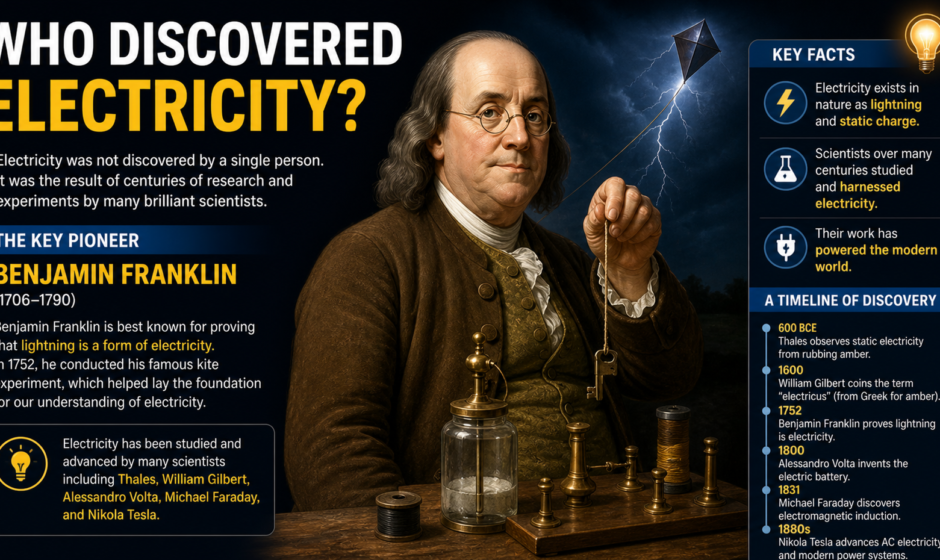
By the mid-1700s, scientists were obsessed with “electric fire.” Many believed lightning was a different force altogether until Benjamin Franklin conducted his famous, though incredibly dangerous, kite experiment in 1752.
- The Experiment: Franklin flew a silk kite during a thunderstorm with a metal key attached to the string.
- The Discovery: When the kite was struck by lightning, sparks jumped from the key to his hand, proving that lightning is a form of electricity.
- The Impact: This discovery led Franklin to invent the lightning rod, the first practical application of electrical theory, which protected buildings from fire.
4. When Was Electricity “Invented”? (The Power Era)
While electricity is a natural force that was discovered, the means to generate and distribute it—what many call “power”—had to be invented.
Alessandro Volta (1800): The First Battery
Before 1800, electricity was mostly static (brief sparks). Alessandro Volta changed the world by creating the Voltaic Pile, the first battery. By stacking alternating layers of zinc and copper separated by cardboard soaked in saltwater, he produced a steady flow of electricity (current). The unit of electrical potential, the Volt, is named in his honor.
Michael Faraday (1831): The Electric Motor
If Volta gave us the spark, Faraday gave us the engine. He discovered electromagnetic induction—the process of using a moving magnet to create an electric current in a wire. This principle is the basis for every modern electric generator and motor.
5. The War of Currents: Who Made Electricity Useable?
In the late 19th century, a fierce rivalry broke out over how to power the world’s cities, known as the War of Currents.
- Thomas Edison (Direct Current – DC): Edison invented the first commercially viable incandescent light bulb. He promoted DC, where electricity flows in one direction. However, DC could not be transmitted over long distances.
- Nikola Tesla (Alternating Current – AC): Working with George Westinghouse, Tesla championed AC. Using transformers, AC could be stepped up to high voltages and sent hundreds of miles, making it the standard for the modern power grid.
6. Summary of Key Contributors
| Person | Period | Contribution |
|---|---|---|
| Thales of Miletus | 600 BC | First observation of static electricity in amber. |
| Benjamin Franklin | 1752 | Proved lightning is electricity; invented the lightning rod. |
| Alessandro Volta | 1800 | Invented the first battery (chemical electricity). |
| Michael Faraday | 1831 | Discovered induction; invented the electric generator. |
| Nikola Tesla | 1880s | Developed the AC power system used in modern homes. |
7. Conclusion: A Multi-Generational Discovery
Electricity wasn’t discovered by one person in a single night. It was a relay race of genius: from a Greek philosopher’s amber to Franklin’s kite, Volta’s battery, and Tesla’s grid. Today, we don’t just “discover” electricity; we rely on it as the lifeblood of our digital and physical world.